

Words About Winter
Faintly Seeing the End from Mid-way Through

Almost mid-month of February, we will soon, in my mind, be on the downhill side of the shortest month that always seems to me the longest. At the end of the hill, March: the month of false hope, but hope nevertheless: a few spring peepers are awake, early and briefly. Maple buds swell enough to notice and pink up to red over months. And March, the very edge of spring. But first, more winter.
The paragraphs below come from winters past—memories for good or ill. Winter wind especially is without excuse for its cruetly and persistence. … the following from the twenty-oughts and far away.
Today we enjoy the mixed blessing of the January Thaw. It is a bit early, but why not? Every other aspect of the weather has thumbed its nose at the predictions over past months. A weatherman’s air mass, we have seen, can be mutinous and surly as a spoiled teenager, and without warning, aim a high-powered wind that brings down the roof on the heads of unsuspecting Wal-mart shoppers in Texas.
The January Thaw is a teaser, a tiny packet of pretzels on the agonizingly long flight to spring. After more than a month of deep freeze and ice in December, the subsoil is still hard as iron, down to the frost line. But this week’s thaw has temporarily softened the top few inches that slip and slide around under foot and tire like chocolate pudding on a rock.
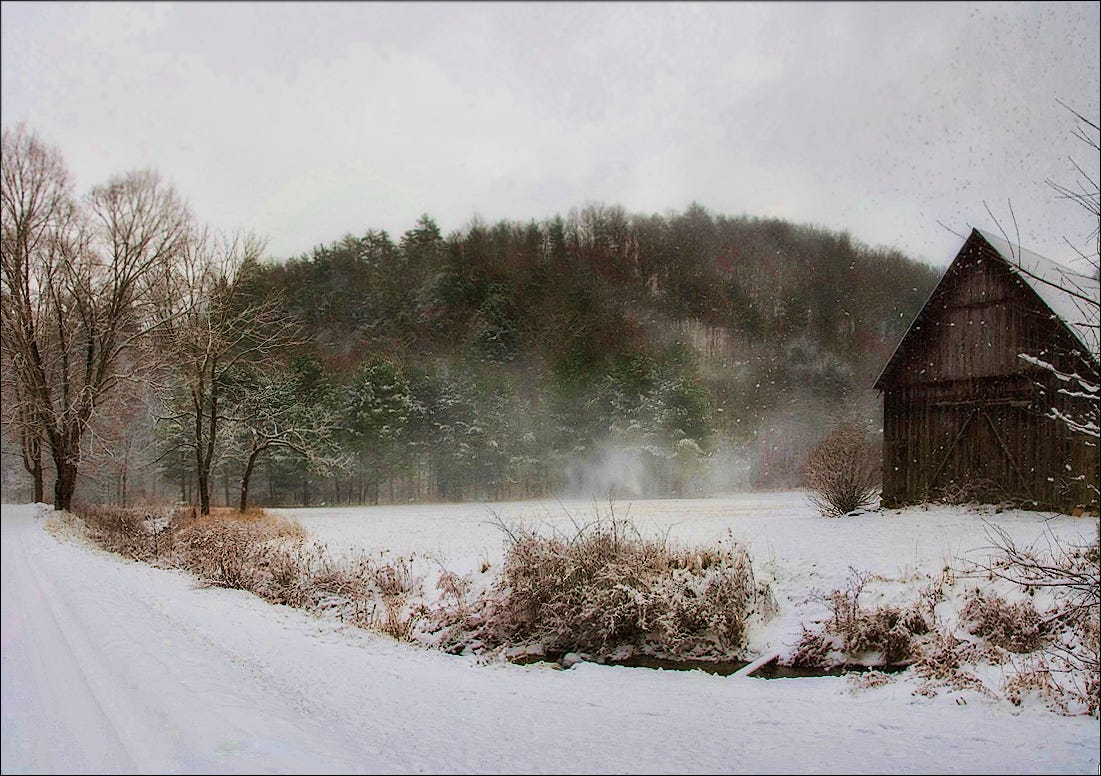
Working pastures and fields are rutted with brown swerving parallel scars from trucks that finally reach the livestock, who stand around in muddy boots, up to their hocks in pasture muck. Should the seasons relent their rebellious tirades and decide to play by the rules, the Season of Mud won’t start for real, more or less predictably, until sometime in late March.
The streets of downtown are stained by cinders and salt, leaving crime-scene outlines to mark where the gray mounds of snow have finally vanished. The warmth of the January Thaw this week has sent flake and crystal down the city drains, heading now for Little River, and then north through the New, the Kanawha and Ohio, then looping back south to the Gulf of Mexico where inland cold waters will retire on a warm beach on the Mississippi coast.
Cars and trucks along the street during the Thaw are gray-brown, the color of lost dogs, embarrassed to be seen looking so forlorn. But what’s the point in taking a bath, they ask. In this short, warmer chapter that falls between pre-winter and real winter, the mud falls on the godly and the ungodly alike, so the new Subaru and the old farm-use truck next to it don’t look all that different, mud being a great equalizer in Nature’s homogenizing democracy.
WINDS IN WINTER
Last night the wind screamed overhead like a great circling bird, back and forth from ridge to ridge. Every now and then it would swoop down to clutch at our porch roof and ruffle the metal, making a strange rumbling studio-thunder sound effect. Then the invisible wind would lift again and circle a thousand feet above us, coursing the high places round and round, like a great locomotive caught in a switching yard above the trees, bare and ravaged along the western crest.
Now summer winds throw angry tantrums like this just briefly, and only when performing the accompaniment to a summer thunder storm. A million green living leaves modulate the pitch and timbre of the wind, so that even in the summer gale there is a softness, a lifting and cleansing quality—a redeeming nature and attitude that is altogether missing from wind in winter.
Summer wind appears at the height of the storm, strutting and fretting about briefly; and then it exits stage left and its pitch falls off, Doppler-like, and only a cooling breeze is left behind. I have no complaints to register against the winds of summer.
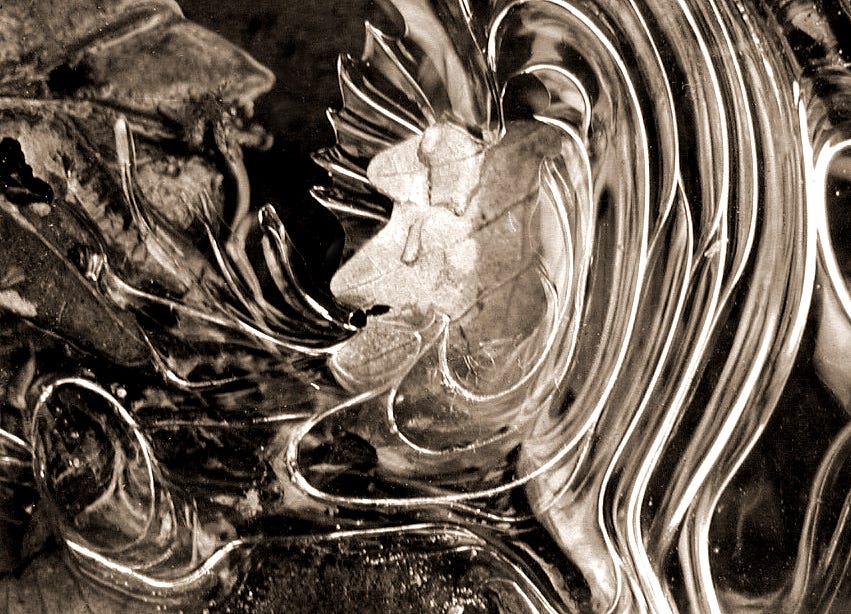
But winter wind arrives here irritable and there is no cheering it up. Dense and gray, heavier than air, it sinks into our valley like a glacier of broken glass, pushing down against the hard and frozen earth, and it will not relent. When the wind howls at midnight, I dream of the Old Man Winter of children’s books, his cheeks bloated full, lips pursed and brow furrowed, exhaling a malevolent blast below at frail pink children in cold, wet mittens.
If you listen, you may think you hear a tone to the roar of January wind, a discrete pitch of a note that you could find on a piano keyboard. But this isn’t so. In the same way all rainbow colors blend to make white light, January wind is the sound of all tones that nature can create, at once together as the Old Man overhead blows through a mouthpiece formed of ridge and ravine, across reeds of oak and poplar trunks.
Winter wind is the white noise of January that won’t go away.
WINTER WALK
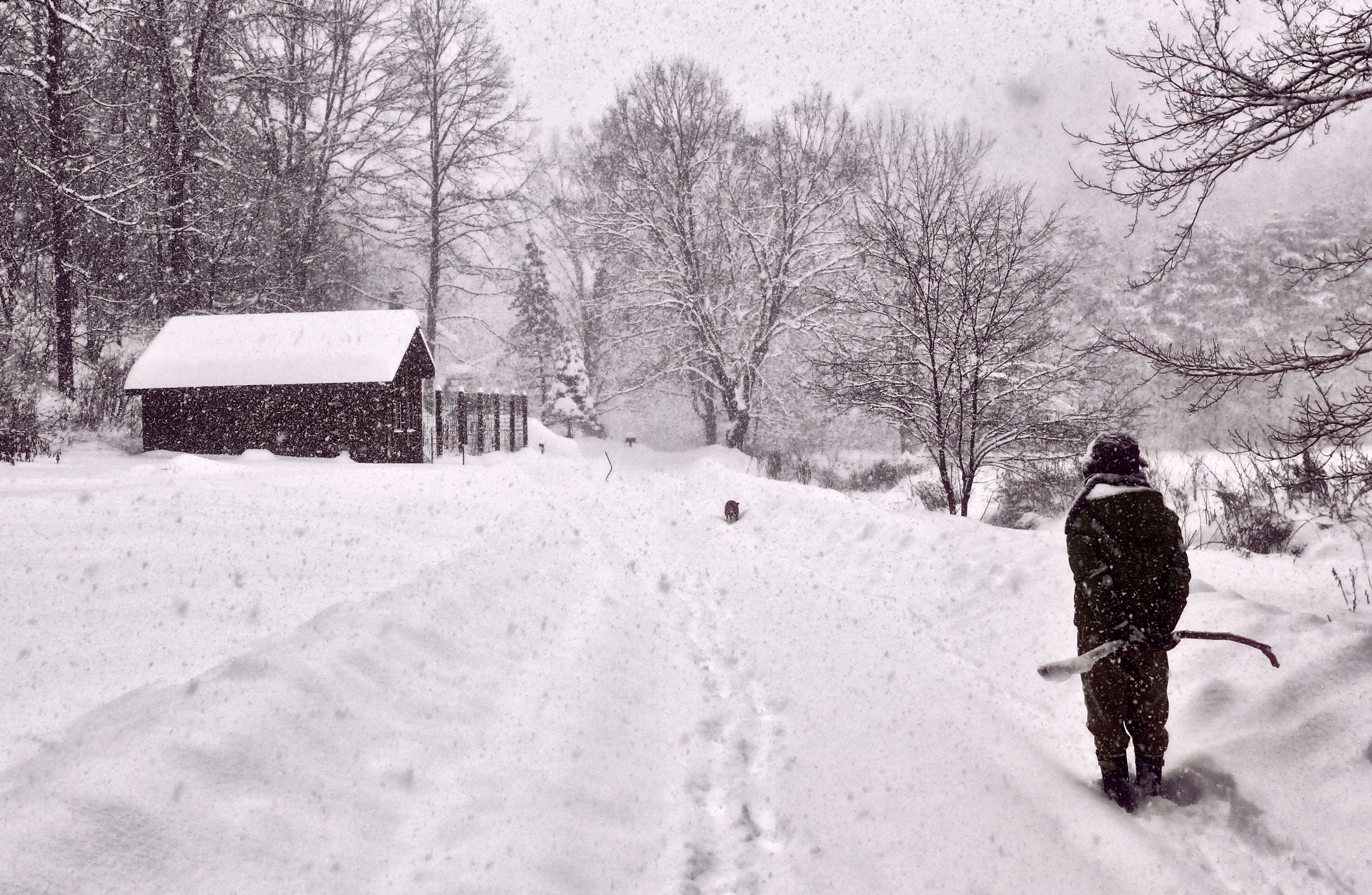
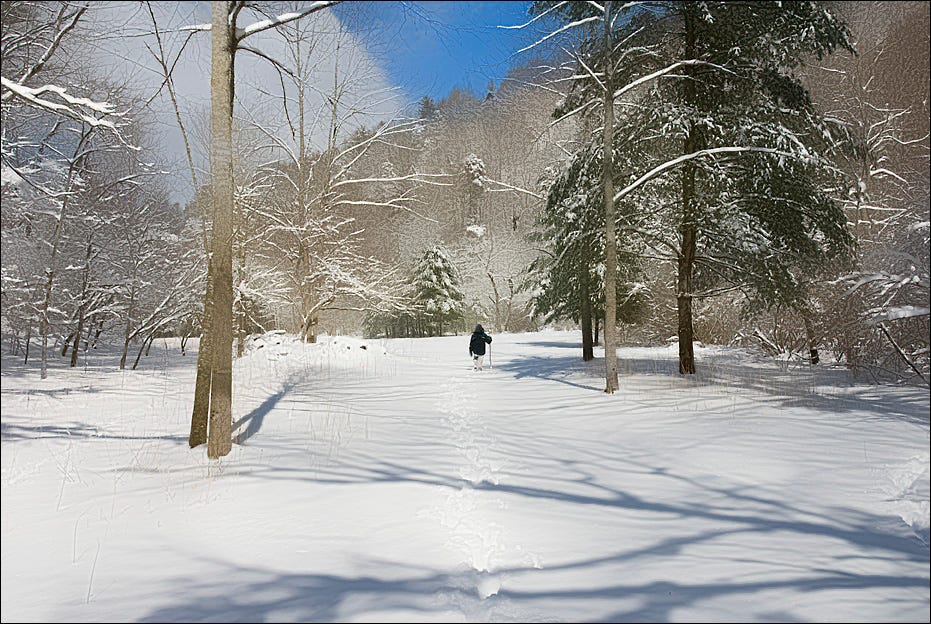
When winter comes, our morning walks do not end. But they are no longer a come-as-you-are tiptoe through the woods. Winter walks are a deep-sea dive into cold and dark, in a submersible of wool and down.
Peeking out from under visors and toboggans like diving helmets, we trudge heavily against the stern and biting currents of polar air flowing like waves over us. Without our encumbering spacesuits our frail pink flesh would turn blue and brittle as December leaves, and our expedition would never be heard from again.
It takes determination, planning and a certain degree of masochistic joy in suffering, or at least a willing deprivation of comfort, to take a walk in winter.
Oh how I loved reading again winds in winter! That is pure poetry, Fred. And seeing your photos again was a treat, too.
Beautiful, again and again.